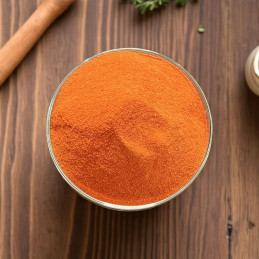
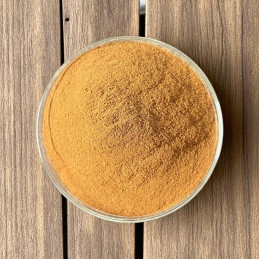
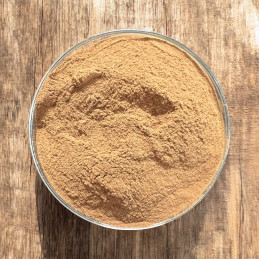
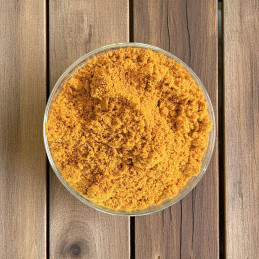
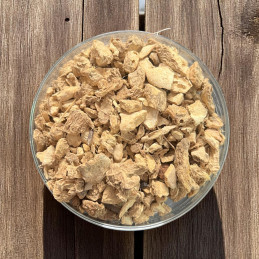
Livré en sachet refermable
- Sans OGM - Sans ionisation - Récolte manuelle - Séchage à l'air libre -
Uses in Cooking and Beyond:
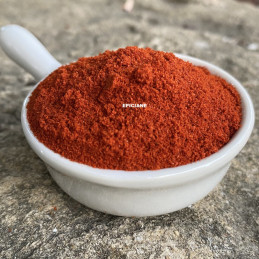
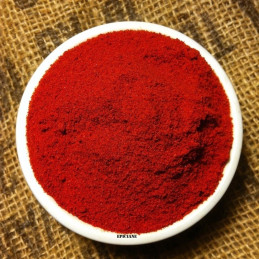
Mugwort is primarily used for its natural coloring ability, which ranges from pale yellow to red, rather than for its nearly nonexistent flavor.
Its coloring pigments are bixine and norbixine. Bixine is liposoluble, meaning it dissolves well in oil, providing a red hue, while norbixine is water-soluble, giving a yellow-orange tint. Norbixine also offers skin protection against UV rays.
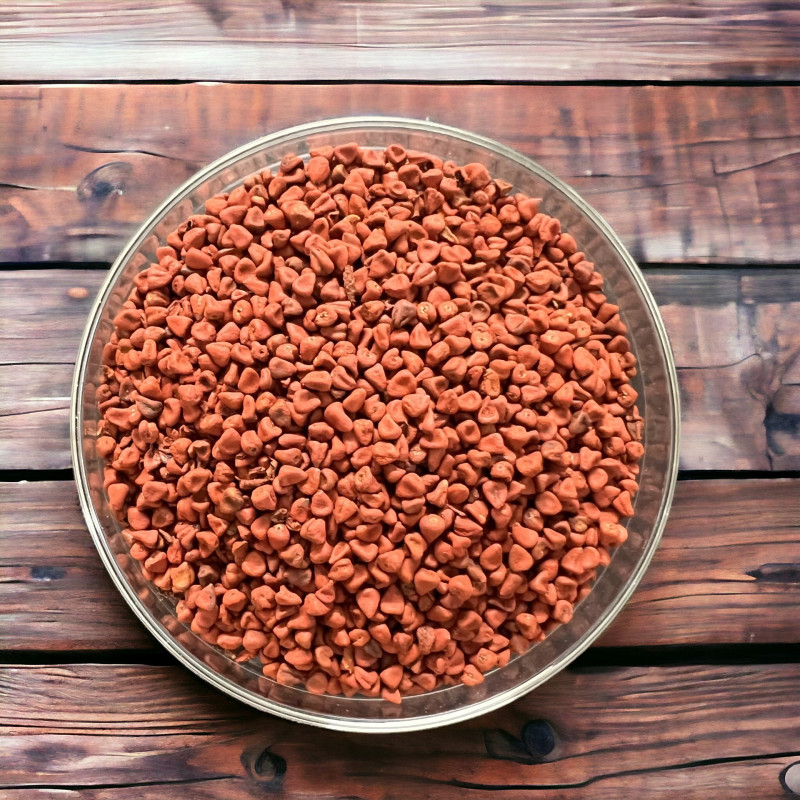
To use annatto, mix it with vegetable oil or pre-heated water (10g of annatto for 100ml of oil or water). Let it steep for a few days until the seed coating softens and the black seeds are released from inside. Remove the black seeds, press the remaining pulp to extract all the juice, and then filter the solution (e.g., through a coffee filter). Alternatively, you can blend the whole seeds and then mix the resulting powder with water or oil in the same proportions. Allow it to rest and remove the sediment by filtering again. You will then have red oil or red water that can be diluted in your dishes and other preparations.
Annatto is also used as a self-tanner, promoting melanin production. You can add it to a day cream, for example, to give your skin a beautiful tanned hue while providing some relative protection against UV rays—though it should not replace commercial sunscreen! Additionally, as noted by Native Americans, it helps repel insect bites and has healing properties for minor wounds, slowing skin aging due to its antioxidant content.
In woodworking, annatto can also be used to color furniture wood, bamboo, rattan, and wickerwork, although only for indoor use due to its light sensitivity. For this purpose, it is sometimes mixed with turmeric to achieve the desired shade.
Who Am I?
Origin: India
Scientific Name: Bixa orellana
Common Names: Annatto, achiote (in Bolivia), urucum (in Brazil), lipstick tree.
The annatto tree is a large shrub native to tropical regions of the Americas. It produces beautiful, numerous pinkish-purple flowers with multiple stamens, allowing for two harvests per year. The fruits are initially green, turning red and covered in spines. When mature, they open to release bright red seeds that are viscous and soft when fresh, becoming hard after drying.
It’s important not to confuse natural annatto with the colorant E160b, derived from chemical processes. This colorant is extracted from the red wax that surrounds the seeds. This is how it imparts color to certain cheeses, like Avesnes cheese, mimolette, cheddar, edam, as well as cookies, pastries, ice creams, confections, smoked fish (haddock), oils, butters, and spirits. It is also found as a colorant in cosmetics and some pharmaceuticals, making it one of the most widely used colorants globally.
Annatto contains a high amount of vitamin E, selenium, magnesium, calcium, and beta-carotene, responsible for its strong coloring power.
A Little History :
South American and Caribbean Indians used (and still use) annatto seeds as body pigments, leading to the term "red skin" used by Europeans. They also employed it for religious rituals, including body war paints.
The Aztecs mixed annatto with cacao to enhance its color appeal.
Europeans also appreciated the color it imparted to the lips of Indian women, leading to the introduction of the ancestor of lipstick in Europe!
Today, it is cultivated in Southeast Asia, having been introduced in the 17th century. It was during this period that European traders brought these seeds back in large quantities as the first plant-based food colorant.